


By EATA Strategy Group*
How a strategy becomes visible in practice
The work of the EATA Strategy Group is not described as a fixed plan, but as an evolving process in which both the content of the strategy and the way of working together are continuously shaped in interaction.
Rather than starting from a predefined blueprint, the group works with an orientation point, sometimes described as a lighthouse. This lighthouse does not dictate the exact path, but provides direction. The path itself emerges through the work, through dialogue, and through the projects that are taken on.
This already marks a shift from more traditional strategy models, where first the destination is fully defined and only then the route is designed. Here, movement and learning are part of the design itself.
The essence: from niche to presence
Across the different voices, a shared intention becomes visible. The strategy aims toward a future in which Transactional Analysis (TA) is no longer a niche, but a recognized and visible modality within psychotherapy and other fields. TA should carry more weight, be more widely known, and be present in practice, research, and education across Europe.
At the same time, the focus expands beyond external positioning. The group describes the strategy as strengthening connection within the organisation: between committees, between people, and across roles. Visibility in the outside world is directly linked to coherence and collaboration on the inside.
The “tree” as organizing principle
One of the most powerful images used by the group is that of a tree. This is not just a metaphor, but an organising structure for the work.
The tree holds:
- several main directions (emerging from earlier council work)
- an explicit additional dimension: culture
- multiple branches and twigs, each representing concrete projects
All projects are placed within this structure. This allows the group to continuously see how individual initiatives contribute to the whole.
Each project is not an isolated activity, but a living branch of the tree.
And importantly:
each branch has ownership and accountability.
Projects, sponsors and accountability
A central shift in the way of working is the move toward project-based execution, supported by charters.
Each project:
- Has a clear scope (what is inside / outside)
- Identifies stakeholders and contributors
- Is supported by a sponsor (often from the executive level)
- Carries explicit accountability
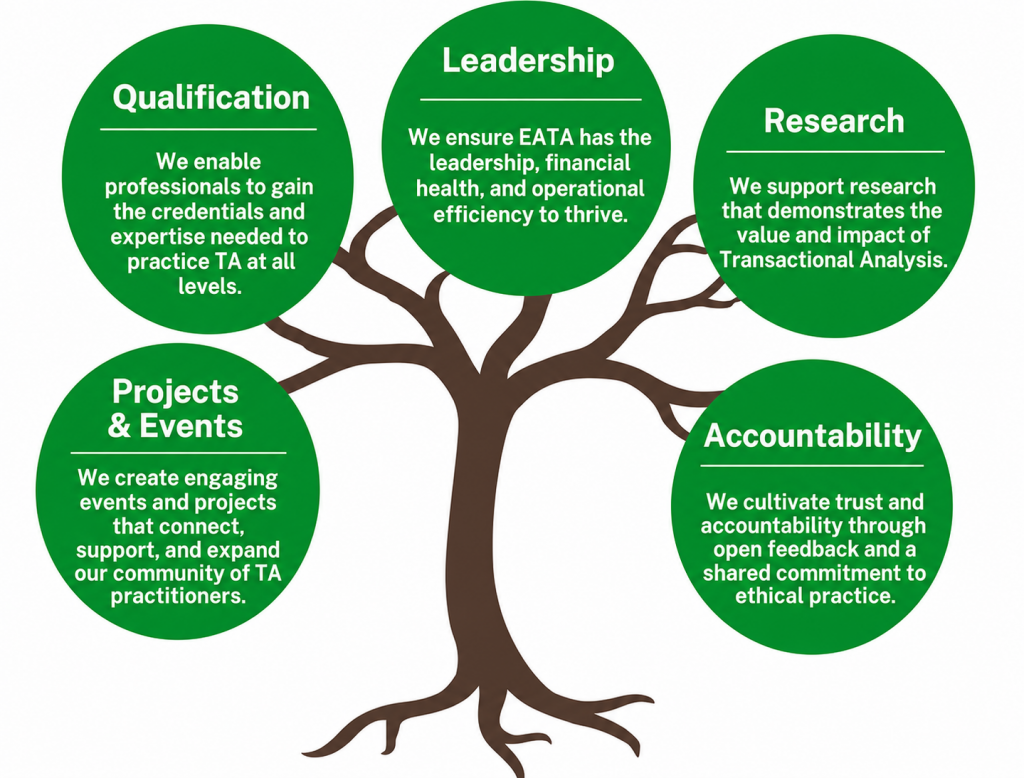
The Strategy Group’s “tree” model (introduced in the previous issue), illustrating how projects and initiatives are supporting EATA’s future..
Accountability is repeatedly described as a key cultural value. It is not only about responsibility for tasks, but about creating continuity in a system where people change frequently.
Because EATA is largely volunteer-based and experiences ongoing turnover, the group intentionally moves knowledge out of individuals’ heads and into structures. The combination of projects, charters, sponsorship and accountability ensures that work can continue beyond individual involvement. In this sense, accountability becomes a stabilising force in a fluid system.
Making collaboration visible
In practice, the strategy becomes tangible through cross-committee collaboration. Projects bring together people from communication, IT, research, exam, and other committees, creating new forms of interaction that go beyond traditional boundaries. Participants describe this as a shift: from working within committees to working across them. What stands out is the intensity of communication, the sharing of perspectives, and the willingness to engage with different viewpoints. The process is experienced as strongly relational: dialogue, reflection and exchange are essential elements of progress.
A process that allows emergence
Another characteristic of the group’s way of working is the acceptance of not knowing at the start. Rather than forcing clarity early, the group allows understanding to emerge over time. This requires trust in the process, and the ability to stay with ambiguity. Learning is therefore not a side effect, but part of the method and fully intended. Moments of disagreement or incompleteness are not avoided. Instead, they are used to improve the outcome. For example, when it became clear that “culture” was underrepresented in the model, the group revisited and reworked its structure, leading to a more complete and aligned result.
Time as a condition for quality
A recurring element in the reflection on collaboration is the role of time.
Even within relatively short meetings, there is an experience of spaciousness: ideas are given time to unfold, perspectives can be placed next to one another, and conclusions are not rushed. This creates what participants describe as a surprisingly “unstressful” environment, despite the complexity of the work.
Time, in this sense, is not just a practical constraint, but a condition for depth and quality, while a sense of urgency for progress is maintained within the group.
Diversity and representation
The group ensures diversity primarily through its composition:
- Different countries
- Different committees
- Different professional backgrounds
This creates a networked system, where each member remains connected to a broader context (“home committee”) and can bring perspectives in and out of the group. In this way, the strategy work is continuously informed by the larger system it serves, and vice versa.
Building for the next generation
Looking toward the future, the intention is not only to achieve certain outcomes, but to leave something behind.
This includes:
- Structures
- Ways of working
- Documentation and shared understanding
The aim is that future generations of TA practitioners and EATA members can enter a system that already supports connection, collaboration and clarity. Organizational learning is therefore embedded in the system, rather than residing in individuals.
Identity: from structure to navigation
When reflecting on the identity of the Strategy Group, participants do not describe it as a decision-making body. That would be the role of the Executive Committee.
Instead, it is seen as something closer to a navigation system.
Metaphors point in this direction:
- Building channels through which impact can flow
- Creating connections (like wiring)
- Shaping conditions for movement
The group does not define the strategic direction, this remains the role of the executive level.
Its focus is on how the work is carried out: strengthening execution, alignment and continuity.
In that sense, the Strategy Group can be understood as the infrastructure of navigation:
not steering the ship directly, but enabling it to stay on course.
Many warm thanks to the members of the Strategy Group
* Alan Jones delegate in TDRC, Tanja Krist delegate in CC, Nadica Skeparoska delegate in ECC Mayke Wagner delegate in COC, Orsolya Frank delegate in TDRC, Sylvia Schachner EATA President, Mike Kercher Operations Officer, for a conversation in which time seemed to expand rather than pass. Your clarity, openness and shared thinking made this work a joy.