

Category: Voices from the Committees

  • Uzhhorod 2026: Examinations as a Commitment to European Values

    Uzhhorod 2026: Examinations as a Commitment to European Values

    By Christoph Seidenfus,

    COC Chairperson

    On 8 and 9 June 2026, EATA examinations took place in Uzhhorod, Ukraine. An unusual location given the strain the country is under because of the Russian invasion and the ongoing war. These were highly successful examinations, resulting in 8 new CTAs and 3 new TSTAs.

    The decision-making process between the EC and the COC was shaped by attention to the values of EATA, on which our association rests as a European professional community: professionalism, diversity, accessibility, mutual respect, and the promotion of development across national borders. If EATA wishes to stand for a European community of Transactional Analysis, that aspiration must also be reflected in the geographical and cultural reach of its examination and networking structures.

    It is worth reflecting on the strategic reasons why, in future, smaller countries and those in Eastern and South-Eastern Europe in particular might be given greater prominence in the examination and association’s activities. There are not only organisational and reputational reasons for this, but also reasons grounded in the values of our Transactional Analysis community.

    A first strategic reason lies in strengthening European legitimacy. If examinations, certifications, and central visibility are concentrated mainly in a few Western and Central European countries, this can easily create the impression of a de facto centralised system. That may unintentionally lead to distance, frustration, or a sense of structural marginalisation, particularly among colleagues from smaller countries or regions that have historically been less strongly embedded in European professional networks. By contrast, a deliberately broader inclusion signals that EATA is not merely an examination body, but a genuine European community. Especially in times of political tension and differing economic conditions, this symbolic effect should not be underestimated.

    A second point concerns the sustainability of talent development. In smaller countries and in Eastern and South-Eastern Europe, there are often committed TA practitioners, but local structures are necessarily more fragile. If examinations are held closer to these regions, or if they are given targeted consideration, barriers to access, as well as travel and cost burdens, are reduced, and so too are the hurdles faced by candidates. Strategically, this means that EATA expands its pool of qualified professionals, increases the likelihood of long-term membership, and supports the development of stable local training and supervision cultures. Where access is made easier, commitment grows; where commitment grows, continuity emerges.

    For Eastern and South-Eastern European countries in particular, the aspect of resilience through participation is also important. These countries are especially affected by economic imbalances, demographic outmigration, and, in some cases, political uncertainty. When an international professional community is present in such contexts, it has a stabilising effect. This applies not only to individual examinations, but to the wider environment: contact between trainers, examiners, candidates, and national associations promotes professionalisation at local level. EATA would thus not merely be reacting but actively contributing to TA competence growing even where conditions are more difficult. That is precisely where a strategic investment in the future of European TA lies.

    It is important here to distinguish between the examination process with its certifications and the relationships within the European TA community. The examination process must, of course, remain rigorous, fair, and quality-assured. Certifications such as CTA and TSTA have significant professional value and must not be diluted by regional sentiment. The point is therefore not to lower standards or politicise examinations. On the contrary, the only strategically sound approach is one that combines high standards with broader accessibility. The quality of the examination remains unchanged, but its distribution, accessibility, and cultural resonance are shaped more consciously.

    Relationships within the community follow a different logic from formal certification. Here, the focus is on belonging, exchange, visibility, mentorship, and cultural understanding. This is precisely the level at which EATA can gain much by giving smaller countries, or regions in Eastern and South-Eastern Europe, greater consideration. The community is then experienced less as a centre with a periphery, and more as a network of mutual enrichment. This is strategically relevant because professional associations are sustained not only by examinations, but also by identification, loyalty, and informal cooperation. Those who feel seen and taken seriously are more likely to remain engaged over the long term.

    From a reputational strategy perspective, too, broader geographical openness makes sense. An organisation that not only proclaims diversity, but visibly lives it, strengthens its credibility both internally and externally. In a time when European values are under pressure, it sends a powerful signal when a professional association is present not only in the larger and economically stronger countries, but consciously includes those regions that need more support structurally. This applies not only to Ukraine, but more generally to countries at the margins of the traditional European professional landscape. Such a policy is not an act of charity, but an expression of strategic foresight.

    A stronger consideration of smaller countries and those in Eastern and South-Eastern Europe also promotes the diversity of perspectives within TA. Different historical experiences, institutional cultures, and social contexts enrich both theory and practice. If EATA systematically incorporates this diversity, it can deepen its substantive work and improve its relevance across different fields of practice. This makes the organisation intellectually more robust. An association that thinks only from within a limited cultural horizon risks overlooking important developments; one with a broader geographical base gains in critical capacity and reflection.

    Taken together, there are compelling reasons why EATA should in future give greater consideration to smaller countries, especially those in Eastern and South-Eastern Europe. The issues at stake are legitimacy, reach, resilience, the development of new talent, and the credibility of a genuinely European TA community. What matters most is the balance: high examination standards on the one hand, and conscious relationship- and structure-building on the other.

    By thinking these together, EATA strengthens not only individual countries or regions, but the future viability of the association as a whole.

    Christoph Seidenfus, COC Chairperson

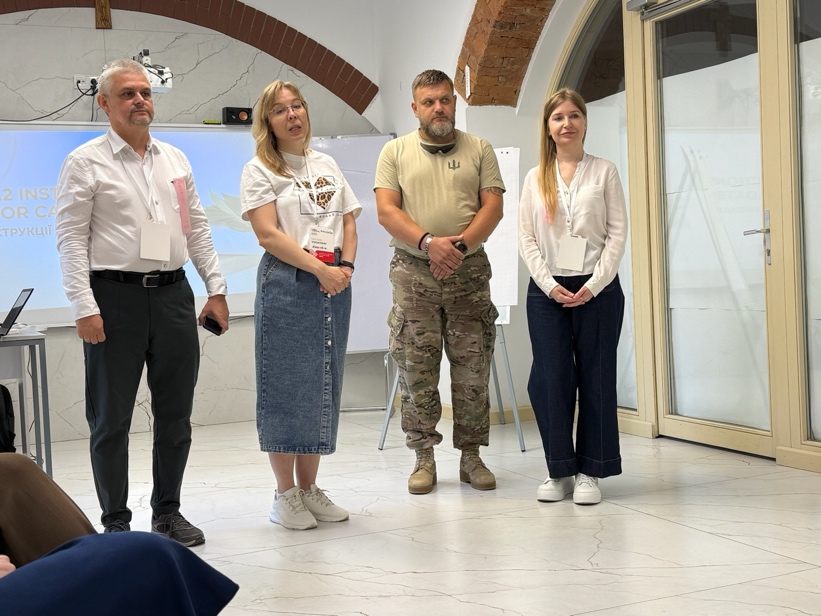
    The Ukrainian exam team at the briefings with 8 CTA- and 3 TSTA-candidates:

    LES CTA: Serhii Mordiushenko

    Translator: Oleksandra Gudkova

    Military services: Wolodymir

    LES TSTA: Hanna Yavorska

    Happy candidates at the celebration of their exam at the ballroom in the Old Continental Hotel in Uzhhorord.

  • Online Examinations: A Step into the Future

    Online Examinations: A Step into the Future

    As EATA continues to evolve, the introduction of online examinations marks an important milestone in our collective future. This shift not only increases accessibility for candidates across regions, but also reflects a broader movement towards flexibility, inclusivity, and modernisation within our professional community. In this contribution, Mayke, Nikki, Tin and Valérie offer an overview of the new online examination process and its significance for the years ahead.

    This shift not only increases accessibility for candidates across regions, but also reflects a broader movement towards flexibility, inclusivity, and modernisation within our professional community. In this contribution, Mayke, Nikki, Tin and Valérie offer an overview of the new online examination process and its significance for the years ahead. Her insights help us understand how this development supports the long-term direction of EATA and the continued growth of TA across Europe.

    EATA is very pleased to announce the possibility for our members to take their CTA exam, their CTA Trainer examination (TOE only) as well as their TSTA examination (TOE only) online on Friday, January 29th, 2027. The complete TSTA-Teach and TSTA-Supervision exams as well as CTA-TS Teach and Supervision exams will be possible as from January 2028.

    This means that as from 2027, both ITAA and EATA adopt the two-fold approach to their examination and certification system: on-site and online. EATA believes that extending the range of opportunities for members to take exams also takes into consideration possible financial restrictions, mobility issues, other DEIA needs and the ecological aspects of not having to travel.

    The online examinations will follow the on-site procedures as closely as possible to ensure the same high-quality standards as the on-site examinations, which will also continue to be run as well. We hope that experienced on-site examiners will make themselves available for the online exams. A special technical Zoom meeting will be held beforehand to give online examiners the opportunity to get acquainted with Zoom.

    EATA is especially grateful to ITAA and the members of the International Board of Certification (IBOC) for their generous support and for sharing their extensive online exams experience. If you wish to apply for an online CTA exam, please send your CTA-oral exam application (form 13.7.3) to the Language Coordinator of your language group.

    For TSTA candidates who wish to apply for their TOE exam, please send your TSTA-oral exam application (form 13.12.4) to the EATA Supervising Examiner: coc.exam.administrator@eatanews.org

    CTA-TS candidates who wish to apply for their TOE exam, please send your exam application (form 13.11.3) to the EATA Supervising Examiner: coc.supervising.examiner@eatanews.org.

    Please always refer to the EATA website for the latest information about the examinations calendar and to the latest edition of the handbook on the EATA website. For further questions regarding EATA online exams, please contact your Principal Supervisor or Mayke Wagner-Froböse for TSTA and CTA Trainer exams (oes.tsta.exams@eatanews.org) or Nikki Millard for CTA exams (oes.cta.exams@eatanews.org).

    Looking ahead, the introduction of online exams represents an important step in ensuring that TA examinations remain accessible, robust and aligned with the needs of our evolving community. We look forward to welcoming candidates and examiners to the online exams in January 2027.

    Mayke Wagner-Froböse, Nikki Millard, Tin Vanderhoeven and Valérie Cionca, delegates in COC

  • Connecting People, Ideas and Opportunities Across Europe

    Connecting People, Ideas and Opportunities Across Europe

    By Valentyna Zakharchenko and

    Iza Bobrowska, Chair of ECC

    The European Connection Committee (ECC) plays a central role in strengthening connection, collaboration and shared development across the EATA community. By linking National Associations, supporting joint initiatives and helping match resources with needs, ECC contributes to a vibrant and interconnected European TA network. Through project support, networking, webinars and cross-committee cooperation, the committee creates opportunities for members and associations to learn from one another and grow together.

    ECC’s work focuses on four interconnected areas that together support the development and visibility of Transactional Analysis across Europe.

    ECC accompanies National Associations in their development, helps new associations take shape and ensures that they remain well connected to EATA structures. This includes offering guidance, sharing experience and helping associations navigate organisational or developmental questions.

    A key part of ECC’s mission is to match resources with needs. The committee supports project development, helps identify funding opportunities and facilitates the exchange of knowledge, experience and good practices. By bringing together the right people and skills, ECC strengthens the capacity of TA communities to grow and innovate.

    ECC works closely with other EATA committees to develop joint initiatives and educational projects. This includes supporting the recognition of Transactional Analysis across all four fields and contributing to cross-committee projects such as international webinars. Through these collaborations, ECC helps create a more integrated and coherent organisational landscape.

    Connection is at the heart of ECC’s work. The committee supports collaboration between National Associations under EATA’s protectorate, encourages sustainable partnerships and creates opportunities for mutual support. By linking experienced and emerging TA communities, ECC helps build bridges that strengthen the European TA network as a whole.

    • Attract new members
    • Increase the number of certified members
    • Promote the development of Transactional Analysis within their country

    To support a strong and well-prepared proposal, a dedicated application form is available here.

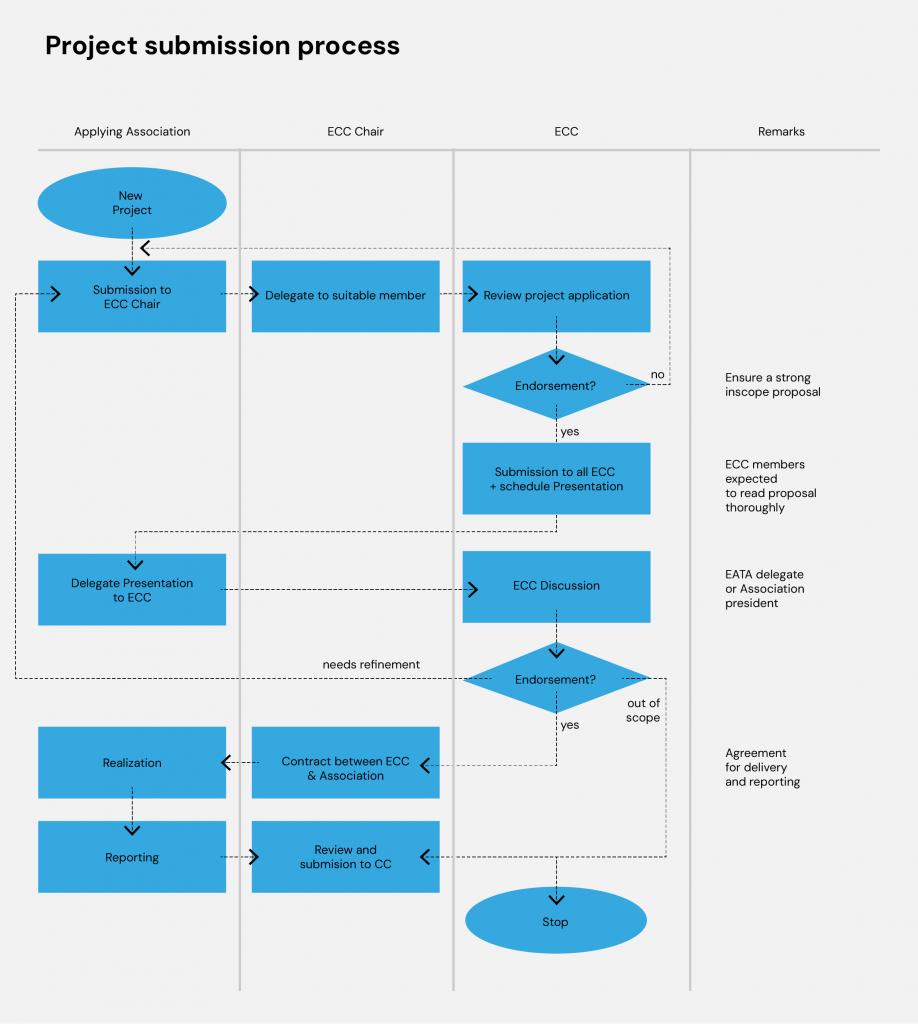
    Once an application has been submitted, the ECC will review and process it in accordance with the steps illustrated in the “Project Submission Process” chart.

    Valentyna Zakharchenko and Iza Bobrowska, Chair of ECC

  • Integrating Practice‑Based Evidence and Evidence‑Based Practice in TA

    Integrating Practice‑Based Evidence and Evidence‑Based Practice in TA

    By Enrico Benelli

    Chairperson of TDRC

    In contemporary psychotherapy, two complementary paradigms guide how we understand effective treatment: Evidence‑Based Practice (EBP) and Practice‑Based Evidence (PBE). While EBP traditionally moves from research to practice, PBE brings knowledge from practice back into research.

    Together, they form a circular model that strengthens both scientific credibility and real‑world clinical relevance.

    The American Psychological Association defines EBP as the integration of:

    • Best available research,
    • Clinical expertise, and
    • Patient characteristics, culture, and preferences.

    This tripartite model emphasises flexibility, relational competence, and tailoring therapy to the individual.

    PBE complements this by grounding knowledge in the daily reality of clinical work. It values data gathered from real clients, including those with comorbidities and complex presentations, and focuses on continuous monitoring of progress, therapeutic alliance, and global functioning.

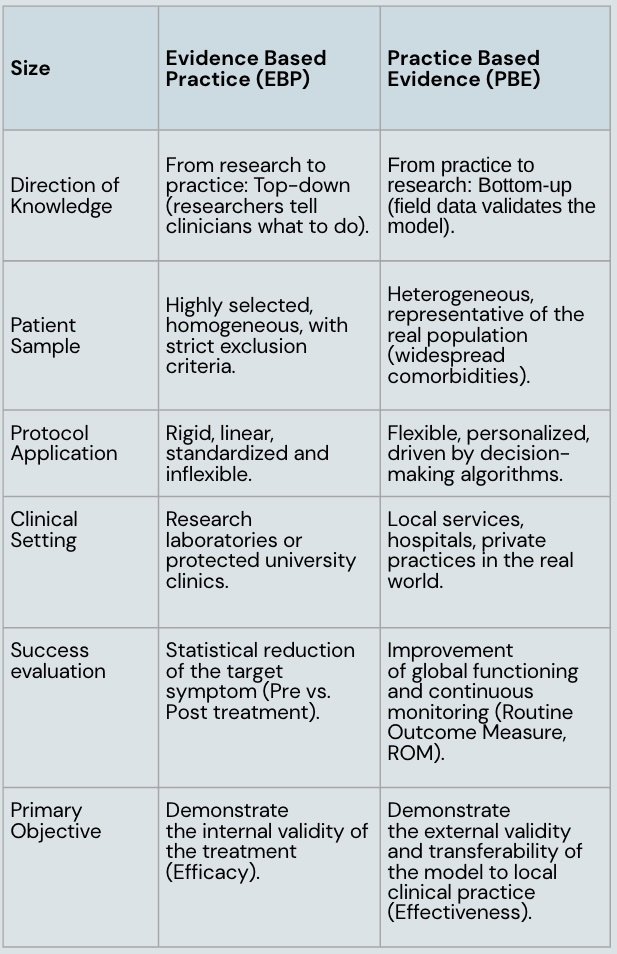
    Enrico’s article highlights the structural differences between the two paradigms. The table below summarises these distinctions and shows why integrating both is essential for modern TA practice. This comparison shows why TA benefits from a circular integration: research informs practice, and practice refines research.

    Table 1. Evidence‑Based Practice vs. Practice‑Based Evidence

    International guidelines (APA, WHO) now emphasise that psychotherapy manuals must be:

    • Flexible and Personalised: Not rigid sequences, but adaptable principles and decision trees.
    • Able to manage Complexity and Comorbidity: Real clients rarely fit a single diagnostic category.
    • Process‑Based rather than Symptom‑Based: Focusing on mechanisms such as emotional regulation, self‑boundaries, and psychological flexibility.

    A PBE‑oriented manual therefore includes:

    • Decision algorithms to tailor interventions,
    • Routine outcome monitoring (ROM) at each session,
    • Fidelity and competence checklists,
    • Deliberate practice exercises to strengthen clinical skill.

    These elements ensure transparency, accountability, and ethical rigour; essential qualities for TA’s continued development.

    Enrico outlines a modern structure for TA manuals that aligns with international standards:

    Chapter 1 – Theoretical Rationale and Model of Change. Conceptual framework, mechanisms of change, and supporting evidence.

    Chapter 2 Clinical Assessment and Eligibility. Inclusion/exclusion criteria, case formulation, and baseline assessment tools.

    Chapter 3 – Structure of the Intervention Setting, duration, delivery format, and therapeutic contract.

    Chapter 4 – Operational Guide. Flexible phases: engagement, core intervention, consolidation, and termination.

    Chapter 5 – Managing Obstacles and Crises Alliance ruptures, repair strategies, and preventing dropout.

    Chapter 6 – Appendices and Tools. Worksheets, monitoring diaries, clinical vignettes.

    This structure supports both scientific replicability and clinical flexibility, making it suitable for real‑world TA practice.

    Enrico’s contribution offers a clear and timely framework for how TA can align with contemporary psychotherapy standards. By integrating EBP and PBE, TA strengthens:

    • Its scientific credibility,
    • Its clinical effectiveness,
    • Its ethical transparency, and
    • Its capacity to evolve within international guidelines.

    This circular approach ensures that TA remains grounded in research while staying deeply connected to the lived reality of practitioners and clients.

    For further exploration of the topic, readers are warmly invited to contact the author, who will be happy to meet and support colleagues interested in this work: tdrc.chair@eatanews.org