Tag: Newsletter 146 – July 2026

  • The EATA-ITAA Memorandum: A Milestone in Ethical Cooperation

    An interview with Ethical Advisor Sabine Blumenstein.

    As EATA celebrates its 50th anniversary, we also take time to reflect on how our community continues to evolve. One important step in this development is the recently signed Memorandum of Understanding (MoU) between EATA and ITAA, a milestone that strengthens ethical cooperation and reinforces our shared commitment to safeguarding the integrity of Transactional Analysis.

    In the conversation below, Ethical Advisor Sabine Blumenstein shares how this collaboration emerged and what it means for the future of ethical practice in our community.

    As Ethics Advisor to EATA, I had the privilege of collaborating with Emma Haynes (UK), Co-Chair of the ITAA Ethics Committee, and committee member Alex van Oostveen (South Africa). Since May 2025, we met almost weekly for 1.5 hours. Through this sustained cooperation, we jointly proposed the Joint Ethics Committee (JEC) Policy and Procedures and the Memorandum of Understanding, which has now been formally signed.

    The MoU establishes a commitment to share critical information between EATA and ITAA in situations where both organisations may be affected. Previously, the independent operation of the two associations created a vulnerability: gaps between the organisations were being exploited, leading to unethical behaviour and harm.

    For example, after an ethics complaint, a person might be excluded from examining within EATA, yet could examine the next day in ITAA exams. Due to confidentiality rules, this information was not shared. The JEC addresses this gap.

    Our hope is to protect Transactional Analysis, our associations, clients, trainees, and colleagues from behaviours that have been identified as unethical. This collaboration feels particularly innovative and important, as it creates a safer environment for our members and for the wider TA community.

    The JEC is built on absolute trust and confidentiality between the two associations, and, through EATA, also with our affiliated associations. This trust exists both on a personal level and on a technical level. For example, we will have a secure and protected IT system to store and exchange information.

    Another important aspect is that in matters of concern or complaints, the protection of the individual is central. Some people say, “This feels like a police force, I prefer to trust.” From my point of view, it is protective and opens a chance to learn. If I am not confronting, I am not offering a moment of development or learning.

    For a long time, we relied on trust, and most individuals respected the rules. Some did not, intentionally or unintentionally. EATA did not monitor these processes, and sanctions from affiliated associations were not visible to us. This created a “mousehole” through which sanctions could be avoided, for example by moving from one association to another.

    Transparency has made this visible. And as our associations grow, these learnings become even more important. The idea of the JEC is to support one another, ITAA to EATA and vice versa, strengthening ethical cooperation across our global TA community.

  • Uzhhorod 2026: Examinations as a Commitment to European Values

    Uzhhorod 2026: Examinations as a Commitment to European Values

    By Christoph Seidenfus,

    COC Chairperson

    On 8 and 9 June 2026, EATA examinations took place in Uzhhorod, Ukraine. An unusual location given the strain the country is under because of the Russian invasion and the ongoing war. These were highly successful examinations, resulting in 8 new CTAs and 3 new TSTAs.

    The decision-making process between the EC and the COC was shaped by attention to the values of EATA, on which our association rests as a European professional community: professionalism, diversity, accessibility, mutual respect, and the promotion of development across national borders. If EATA wishes to stand for a European community of Transactional Analysis, that aspiration must also be reflected in the geographical and cultural reach of its examination and networking structures.

    It is worth reflecting on the strategic reasons why, in future, smaller countries and those in Eastern and South-Eastern Europe in particular might be given greater prominence in the examination and association’s activities. There are not only organisational and reputational reasons for this, but also reasons grounded in the values of our Transactional Analysis community.

    A first strategic reason lies in strengthening European legitimacy. If examinations, certifications, and central visibility are concentrated mainly in a few Western and Central European countries, this can easily create the impression of a de facto centralised system. That may unintentionally lead to distance, frustration, or a sense of structural marginalisation, particularly among colleagues from smaller countries or regions that have historically been less strongly embedded in European professional networks. By contrast, a deliberately broader inclusion signals that EATA is not merely an examination body, but a genuine European community. Especially in times of political tension and differing economic conditions, this symbolic effect should not be underestimated.

    A second point concerns the sustainability of talent development. In smaller countries and in Eastern and South-Eastern Europe, there are often committed TA practitioners, but local structures are necessarily more fragile. If examinations are held closer to these regions, or if they are given targeted consideration, barriers to access, as well as travel and cost burdens, are reduced, and so too are the hurdles faced by candidates. Strategically, this means that EATA expands its pool of qualified professionals, increases the likelihood of long-term membership, and supports the development of stable local training and supervision cultures. Where access is made easier, commitment grows; where commitment grows, continuity emerges.

    For Eastern and South-Eastern European countries in particular, the aspect of resilience through participation is also important. These countries are especially affected by economic imbalances, demographic outmigration, and, in some cases, political uncertainty. When an international professional community is present in such contexts, it has a stabilising effect. This applies not only to individual examinations, but to the wider environment: contact between trainers, examiners, candidates, and national associations promotes professionalisation at local level. EATA would thus not merely be reacting but actively contributing to TA competence growing even where conditions are more difficult. That is precisely where a strategic investment in the future of European TA lies.

    It is important here to distinguish between the examination process with its certifications and the relationships within the European TA community. The examination process must, of course, remain rigorous, fair, and quality-assured. Certifications such as CTA and TSTA have significant professional value and must not be diluted by regional sentiment. The point is therefore not to lower standards or politicise examinations. On the contrary, the only strategically sound approach is one that combines high standards with broader accessibility. The quality of the examination remains unchanged, but its distribution, accessibility, and cultural resonance are shaped more consciously.

    Relationships within the community follow a different logic from formal certification. Here, the focus is on belonging, exchange, visibility, mentorship, and cultural understanding. This is precisely the level at which EATA can gain much by giving smaller countries, or regions in Eastern and South-Eastern Europe, greater consideration. The community is then experienced less as a centre with a periphery, and more as a network of mutual enrichment. This is strategically relevant because professional associations are sustained not only by examinations, but also by identification, loyalty, and informal cooperation. Those who feel seen and taken seriously are more likely to remain engaged over the long term.

    From a reputational strategy perspective, too, broader geographical openness makes sense. An organisation that not only proclaims diversity, but visibly lives it, strengthens its credibility both internally and externally. In a time when European values are under pressure, it sends a powerful signal when a professional association is present not only in the larger and economically stronger countries, but consciously includes those regions that need more support structurally. This applies not only to Ukraine, but more generally to countries at the margins of the traditional European professional landscape. Such a policy is not an act of charity, but an expression of strategic foresight.

    A stronger consideration of smaller countries and those in Eastern and South-Eastern Europe also promotes the diversity of perspectives within TA. Different historical experiences, institutional cultures, and social contexts enrich both theory and practice. If EATA systematically incorporates this diversity, it can deepen its substantive work and improve its relevance across different fields of practice. This makes the organisation intellectually more robust. An association that thinks only from within a limited cultural horizon risks overlooking important developments; one with a broader geographical base gains in critical capacity and reflection.

    Taken together, there are compelling reasons why EATA should in future give greater consideration to smaller countries, especially those in Eastern and South-Eastern Europe. The issues at stake are legitimacy, reach, resilience, the development of new talent, and the credibility of a genuinely European TA community. What matters most is the balance: high examination standards on the one hand, and conscious relationship- and structure-building on the other.

    By thinking these together, EATA strengthens not only individual countries or regions, but the future viability of the association as a whole.

    Christoph Seidenfus, COC Chairperson

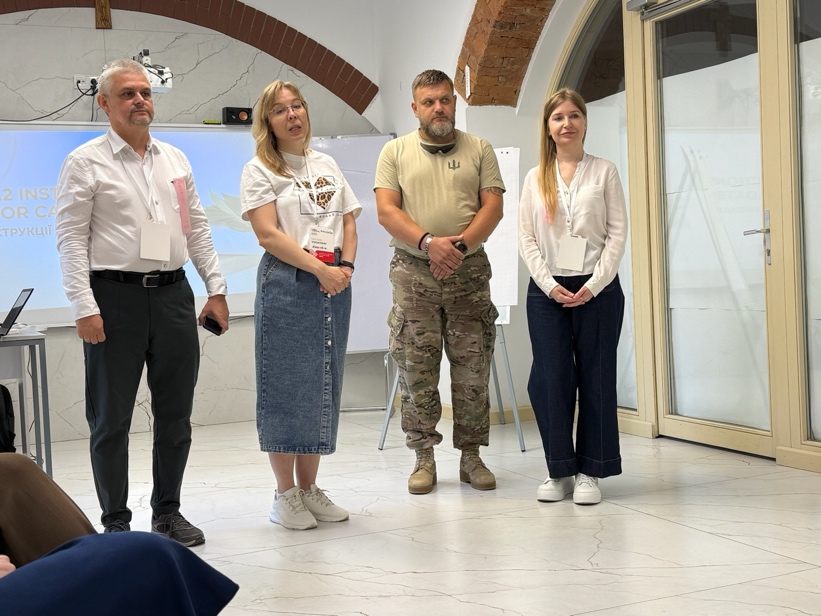
    The Ukrainian exam team at the briefings with 8 CTA- and 3 TSTA-candidates:

    LES CTA: Serhii Mordiushenko

    Translator: Oleksandra Gudkova

    Military services: Wolodymir

    LES TSTA: Hanna Yavorska

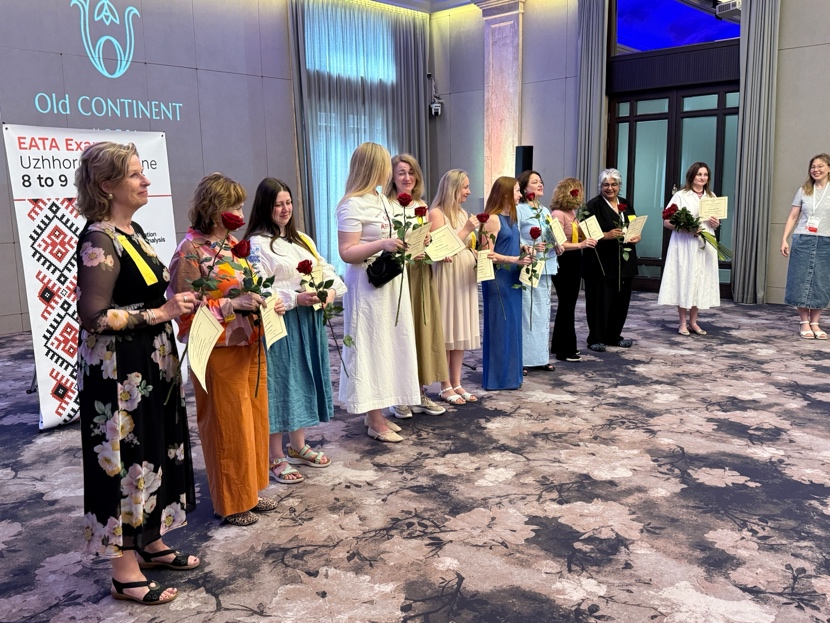
    Happy candidates at the celebration of their exam at the ballroom in the Old Continental Hotel in Uzhhorord.

  • Online Examinations: A Step into the Future

    Online Examinations: A Step into the Future

    As EATA continues to evolve, the introduction of online examinations marks an important milestone in our collective future. This shift not only increases accessibility for candidates across regions, but also reflects a broader movement towards flexibility, inclusivity, and modernisation within our professional community. In this contribution, Mayke, Nikki, Tin and Valérie offer an overview of the new online examination process and its significance for the years ahead.

    This shift not only increases accessibility for candidates across regions, but also reflects a broader movement towards flexibility, inclusivity, and modernisation within our professional community. In this contribution, Mayke, Nikki, Tin and Valérie offer an overview of the new online examination process and its significance for the years ahead. Her insights help us understand how this development supports the long-term direction of EATA and the continued growth of TA across Europe.

    EATA is very pleased to announce the possibility for our members to take their CTA exam, their CTA Trainer examination (TOE only) as well as their TSTA examination (TOE only) online on Friday, January 29th, 2027. The complete TSTA-Teach and TSTA-Supervision exams as well as CTA-TS Teach and Supervision exams will be possible as from January 2028.

    This means that as from 2027, both ITAA and EATA adopt the two-fold approach to their examination and certification system: on-site and online. EATA believes that extending the range of opportunities for members to take exams also takes into consideration possible financial restrictions, mobility issues, other DEIA needs and the ecological aspects of not having to travel.

    The online examinations will follow the on-site procedures as closely as possible to ensure the same high-quality standards as the on-site examinations, which will also continue to be run as well. We hope that experienced on-site examiners will make themselves available for the online exams. A special technical Zoom meeting will be held beforehand to give online examiners the opportunity to get acquainted with Zoom.

    EATA is especially grateful to ITAA and the members of the International Board of Certification (IBOC) for their generous support and for sharing their extensive online exams experience. If you wish to apply for an online CTA exam, please send your CTA-oral exam application (form 13.7.3) to the Language Coordinator of your language group.

    For TSTA candidates who wish to apply for their TOE exam, please send your TSTA-oral exam application (form 13.12.4) to the EATA Supervising Examiner: coc.exam.administrator@eatanews.org

    CTA-TS candidates who wish to apply for their TOE exam, please send your exam application (form 13.11.3) to the EATA Supervising Examiner: coc.supervising.examiner@eatanews.org.

    Please always refer to the EATA website for the latest information about the examinations calendar and to the latest edition of the handbook on the EATA website. For further questions regarding EATA online exams, please contact your Principal Supervisor or Mayke Wagner-Froböse for TSTA and CTA Trainer exams (oes.tsta.exams@eatanews.org) or Nikki Millard for CTA exams (oes.cta.exams@eatanews.org).

    Looking ahead, the introduction of online exams represents an important step in ensuring that TA examinations remain accessible, robust and aligned with the needs of our evolving community. We look forward to welcoming candidates and examiners to the online exams in January 2027.

    Mayke Wagner-Froböse, Nikki Millard, Tin Vanderhoeven and Valérie Cionca, delegates in COC

  • Toward Evidence-Based Transactional Analysis: Past, Present, Future

    Toward Evidence-Based Transactional Analysis: Past, Present, Future

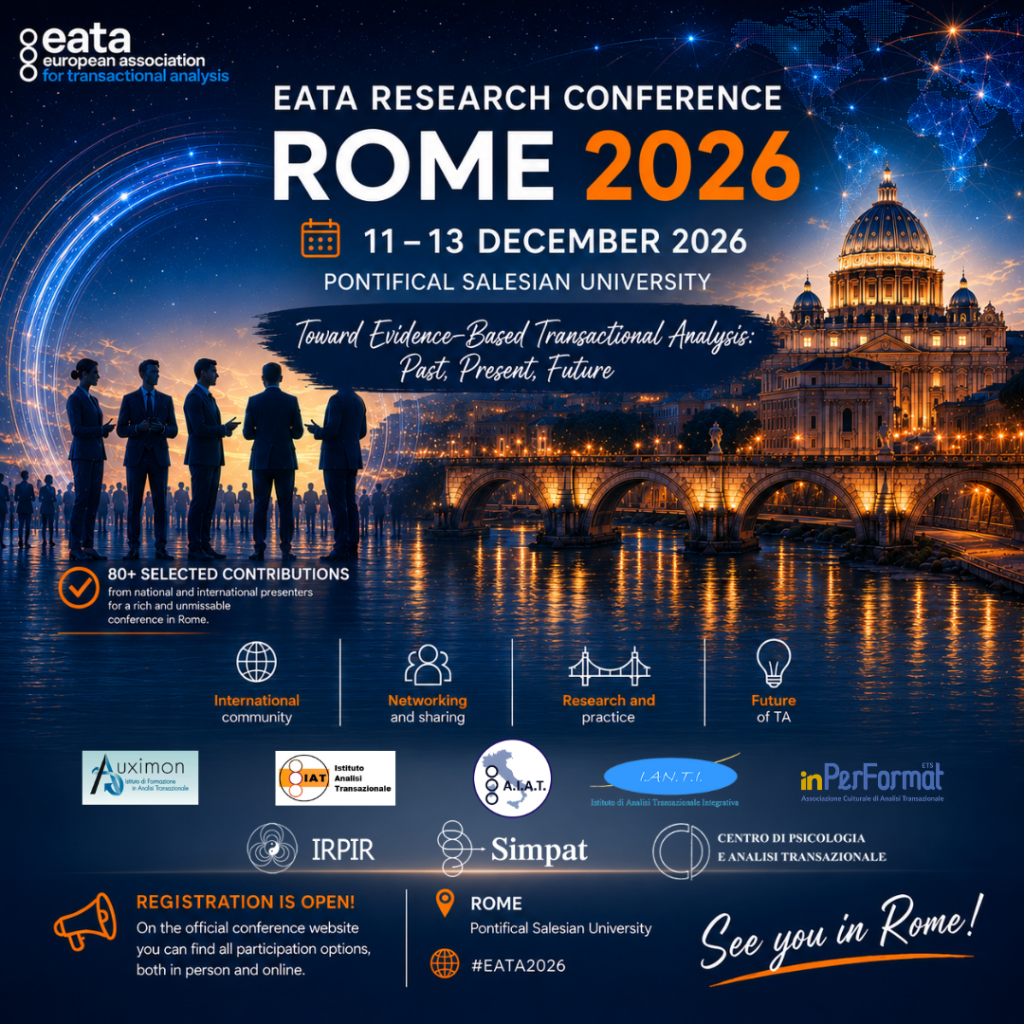
    From 11 to 13 December 2026, Rome will host the EATA Research Conference 2026, dedicated to the theme “Toward Evidence-Based Transactional Analysis: Past, Present, Future.”

    The conference will take place at the Pontifical Salesian University, in a city where history, culture and international exchange meet. This provides a meaningful setting for an event focused on one of the central questions for TA: how to strengthen the dialogue between research, theory, practice and training, while remaining grounded in its relational and humanistic foundations.

    The conference is being developed through close collaboration between EATA and the Italian national TA associations. This shared organisational process reflects the spirit of the event itself: dialogue across differences, collaboration between institutions, and the creation of a common project that honours diversity.

    The response to the Call for Contributions has been highly encouraging. More than 80 selected contributions from national and international presenters will shape a rich three-day programme of papers, workshops, presentations and spaces for dialogue.

    Participants can expect a programme focused on the development of evidence-based Transactional Analysis across its fields of application. The conference offers opportunities to explore how research can support practice in clinical, educational, organisational and counselling contexts, and how practitioners and researchers can learn from one another in a spirit of openness and curiosity.

    At the same time, the event is not only about research, but also about community. It will create space for international encounter, networking and connection, strengthening relationships and contributing to the future development of TA in Europe and beyond.

    The title “Past, Present, Future” invites us to hold together the legacy of Transactional Analysis, the questions that challenge us today, and the responsibility of building a solid and creative future for the discipline.

    The early registration phase has now closed with a very warm response. The regular registration phase is open until 9 September 2026, after which the final registration period will begin, subject to availability.

    We warmly invite all colleagues to join us in Rome to participate, contribute and support the ongoing development of Transactional Analysis.

    All information about participation options, both in person and online, is available at: www.eataconference2026.org

  • Connecting People, Ideas and Opportunities Across Europe

    Connecting People, Ideas and Opportunities Across Europe

    By Valentyna Zakharchenko and

    Iza Bobrowska, Chair of ECC

    The European Connection Committee (ECC) plays a central role in strengthening connection, collaboration and shared development across the EATA community. By linking National Associations, supporting joint initiatives and helping match resources with needs, ECC contributes to a vibrant and interconnected European TA network. Through project support, networking, webinars and cross-committee cooperation, the committee creates opportunities for members and associations to learn from one another and grow together.

    ECC’s work focuses on four interconnected areas that together support the development and visibility of Transactional Analysis across Europe.

    ECC accompanies National Associations in their development, helps new associations take shape and ensures that they remain well connected to EATA structures. This includes offering guidance, sharing experience and helping associations navigate organisational or developmental questions.

    A key part of ECC’s mission is to match resources with needs. The committee supports project development, helps identify funding opportunities and facilitates the exchange of knowledge, experience and good practices. By bringing together the right people and skills, ECC strengthens the capacity of TA communities to grow and innovate.

    ECC works closely with other EATA committees to develop joint initiatives and educational projects. This includes supporting the recognition of Transactional Analysis across all four fields and contributing to cross-committee projects such as international webinars. Through these collaborations, ECC helps create a more integrated and coherent organisational landscape.

    Connection is at the heart of ECC’s work. The committee supports collaboration between National Associations under EATA’s protectorate, encourages sustainable partnerships and creates opportunities for mutual support. By linking experienced and emerging TA communities, ECC helps build bridges that strengthen the European TA network as a whole.

    • Attract new members
    • Increase the number of certified members
    • Promote the development of Transactional Analysis within their country

    To support a strong and well-prepared proposal, a dedicated application form is available here.

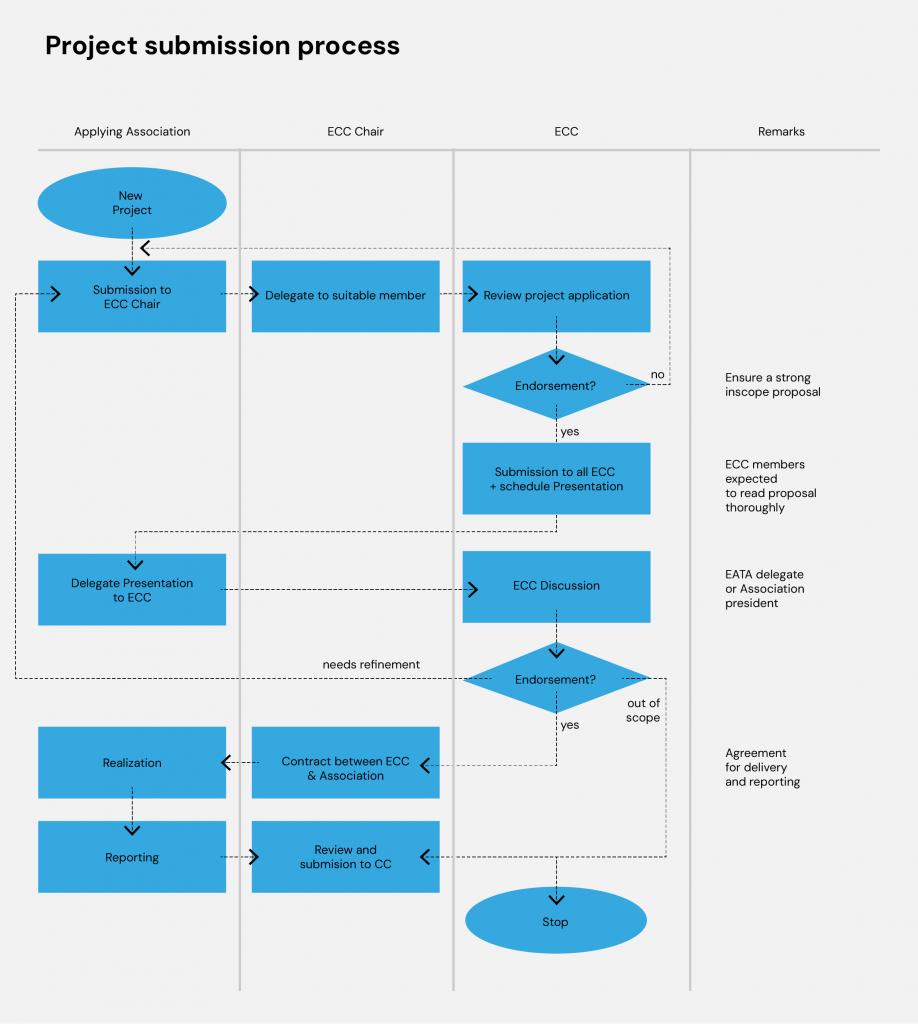
    Once an application has been submitted, the ECC will review and process it in accordance with the steps illustrated in the “Project Submission Process” chart.

    Valentyna Zakharchenko and Iza Bobrowska, Chair of ECC

  • EATA’s Role in the European Psychotherapy Framework

    EATA’s Role in the European Psychotherapy Framework

    by Aleksandra Djuric,

    delegate to the EAP

    As psychotherapy continues to evolve across Europe, collaboration between professional organisations plays an essential role in maintaining high standards and ensuring recognition of the profession. In this article, EAP delegate Aleksandra Djuric offers an overview of how EATA and the European Association for Psychotherapy work together to support the development, accreditation and professional mobility of Transactional Analysis psychotherapists.

    The European Association for Psychotherapy (EAP) was founded in 1991 on the principles of the Strasbourg Declaration on Psychotherapy. Its mission is to standardize, regulate and protect the professional practice of psychotherapy across Europe. Operating through umbrella organisations in more than 40 countries, the EAP pursues several key objectives:

    • Establishing and maintaining high standards of psychotherapy training
    • Awarding the European Certificate of Psychotherapy (ECP)
    • Protecting the public through a central register of accredited ECP holders
    • Advocating for the legal recognition of psychotherapy as an independent scientific profession at both EU and national levels
    • Promoting research and strengthening the connection between scientific evidence and clinical practice

    EATA is represented within the EAP through the European Wide Accrediting Organisation (EWAO) Committee. This committee monitors the development of specific psychotherapy modalities across Europe and evaluates whether they meet EAP criteria for recognition. To achieve recognition, each modality must demonstrate scientific validity according to the EAP’s criteria, including the “15 Questions on Scientific Validity.”

    Once a modality has been recognised, the EWAO may accredit training institutes within that modality as European Accredited Psychotherapy Training Institutes (EAPTIs). EATA appoints a delegate to the EAP for a four-year mandate. In addition, recognised modalities undergo a reaccreditation process every seven years to ensure continued compliance with EAP scientific and professional standards.

    A major current initiative of the EAP is the development of a Common Training Framework (CTF) in cooperation with the European Commission. This framework aims to establish shared professional standards for psychotherapy across Europe. Active collaboration from all modalities represented within the EWAO has been essential to this process.

    Transactional Analysis (TA) is recognised as a modality with particularly high standards in training and supervision. At the same time, continued alignment with emerging common training standards remains important. One example concerns the required number of hours of personal therapy within training programmes. Harmonisation of such standards is crucial for achieving broader recognition of psychotherapy as a profession throughout Europe.

    In parallel, the EAP is working toward the recognition of the European Certificate of Psychotherapy as a qualification aligned with the Common Training Framework. Such recognition would facilitate professional mobility, allowing qualified psychotherapists to practise more easily across EU member states.

    Within this context, the CTA-P (Certified Transactional Analyst — Psychotherapy) credential serves as a fundamental indicator of professional competence and quality standards within the TA modality. CTA-P is a basic requirement for EAP membership as a TA psychotherapist. Furthermore, eligibility for the ECP depends on the continued accreditation of the modality through the EWAO system. Consequently, EATA plays a vital role in maintaining the professional standards, accreditation processes and certification structures that support both the recognition of TA psychotherapy and the wider European framework for professional psychotherapy qualifications.

    Aleksandra Djuric, delegate to the EAP

  • Aligning the Council with EATA’s future. Prague 2026

    Aligning the Council with EATA’s future. Prague 2026

    By Ana-Marija Vidjak

    EATA General Secretary

    The Council, composed of delegates representing national associations, is the key governance gathering of EATA and has traditionally taken place in early July, just before the summer break.

    Following a decision by the delegates last year, the 2026 Council will be held from 10 to 12 October, marking a modest but meaningful shift in timing.

    One of the main motivations for this change is sustainability, including financial considerations. Moving away from the peak holiday season helps reduce overall costs and supports a more responsible use of resources. In addition, recent summers have brought increasingly extreme temperatures in many locations, and October offers a more comfortable environment for focused in-person exchange.

    The nesw timing also allows participants to engage with a clearer and more complete picture of the financial year, supporting better-informed discussion and decision-making at Council level.

    We are aware that there have been different preferences within the membership, with some valuing the long-standing July timing and others welcoming the move into autumn. As with any change in established practice, this adjustment naturally comes with a range of perspectives. We will pay attention to how it works in practice, including both its advantages and its challenges, and remain open to learning from the experience as we move forward. And like many things in life, it may feel slightly unfamiliar at first, and then quietly turn out to make a lot of sense.

    Ana-Marija Vidjak, EATA General Secretary

    By Radmila Pikorová, Jan Šimek and
    Kristýna Tomanová
    – The CATA Board

    This year’s EATA Council meeting will take place in Prague, and on behalf of the Czech Association for Transactional Analysis (CATA), we are delighted to welcome you to the heart of Europe and to the City of a Hundred Spires.

    As Ana-Marija has already announced, the Council meeting has moved to a new date. Alongside this change, we have also decided to experiment with a slightly different hosting format. While previous Councils were traditionally held in hotels that combined accommodation and meeting facilities, this year we felt it was time to try something new.

    For this special anniversary year, we have chosen a meeting venue located in the very centre of Prague and invited Council members to arrange their own accommodation according to their preferences and budget. We hope this approach will offer greater flexibility and perhaps create additional opportunities to experience the city itself. Whether that means a morning walk through the historic centre, discovering a hidden café between meetings, or simply enjoying Prague’s unique atmosphere on the way to and from the venue.

    Of course, the primary purpose of the Council remains the important work we do together. Yet we also hope that being situated in the heart of the city will allow those who wish to do so to combine their Council experience with a small taste of Prague’s beauty, history and everyday life.

    Hosting this Council is a special honour for CATA, not only because it coincides with EATA’s 50th anniversary, but also because it marks a moment of transition for our own association. After eight years of service, the current CATA Board: Radka, Honza and Kristýna, is coming to the end of its term.

    At the same time, Kristýna Tomanová will be concluding her role as Chair of the Communications Committee. Although one chapter is closing, she will remain part of the Communications Committee family as Social Media Manager, continuing to contribute her energy and creativity to EATA’s communication and outreach.

    Yet every ending carries the seed of a new beginning. We are especially pleased that Honza Šimek will continue his journey within EATA as the new Czech Delegate, helping to build on the work of previous years and contribute to the next chapter of cooperation between CATA and the wider EATA community.

    For us, this Council will be more than a meeting. It will be a celebration of fifty years of shared history, a moment to honour friendships and achievements, and an opportunity to look ahead to what comes next.

    We look forward to welcoming you to Prague, sharing with you the beauty and atmosphere of our city, and celebrating this remarkable milestone together beneath its hundred spires.

    See you in Prague!

    The CATA Board: Radka, Honza & Kristýna

  • A conversation with the EATA strategy group

    A conversation with the EATA strategy group

    By EATA Strategy Group*

    The work of the EATA Strategy Group is not described as a fixed plan, but as an evolving process in which both the content of the strategy and the way of working together are continuously shaped in interaction.

    Rather than starting from a predefined blueprint, the group works with an orientation point, sometimes described as a lighthouse. This lighthouse does not dictate the exact path, but provides direction. The path itself emerges through the work, through dialogue, and through the projects that are taken on.

    This already marks a shift from more traditional strategy models, where first the destination is fully defined and only then the route is designed. Here, movement and learning are part of the design itself.

    Across the different voices, a shared intention becomes visible. The strategy aims toward a future in which Transactional Analysis (TA) is no longer a niche, but a recognized and visible modality within psychotherapy and other fields. TA should carry more weight, be more widely known, and be present in practice, research, and education across Europe.

    At the same time, the focus expands beyond external positioning. The group describes the strategy as strengthening connection within the organisation: between committees, between people, and across roles. Visibility in the outside world is directly linked to coherence and collaboration on the inside.

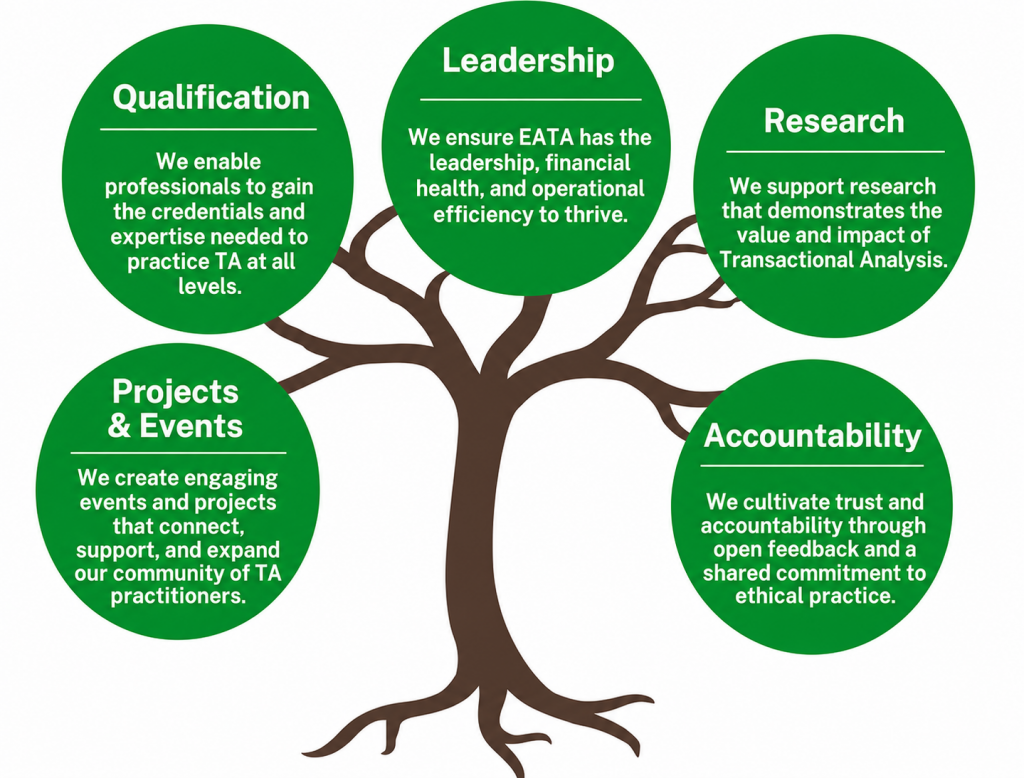
    One of the most powerful images used by the group is that of a tree. This is not just a metaphor, but an organising structure for the work.

    The tree holds:

    • several main directions (emerging from earlier council work)
    • an explicit additional dimension: culture
    • multiple branches and twigs, each representing concrete projects

    All projects are placed within this structure. This allows the group to continuously see how individual initiatives contribute to the whole.

    Each project is not an isolated activity, but a living branch of the tree.

    And importantly:
    each branch has ownership and accountability.

    A central shift in the way of working is the move toward project-based execution, supported by charters.

    Each project:

    • Has a clear scope (what is inside / outside)
    • Identifies stakeholders and contributors
    • Is supported by a sponsor (often from the executive level)
    • Carries explicit accountability

    The Strategy Group’s “tree” model (introduced in the previous issue), illustrating how projects and initiatives are supporting EATA’s future..

    Accountability is repeatedly described as a key cultural value. It is not only about responsibility for tasks, but about creating continuity in a system where people change frequently.

    Because EATA is largely volunteer-based and experiences ongoing turnover, the group intentionally moves knowledge out of individuals’ heads and into structures. The combination of projects, charters, sponsorship and accountability ensures that work can continue beyond individual involvement. In this sense, accountability becomes a stabilising force in a fluid system.

    In practice, the strategy becomes tangible through cross-committee collaboration. Projects bring together people from communication, IT, research, exam, and other committees, creating new forms of interaction that go beyond traditional boundaries. Participants describe this as a shift: from working within committees to working across them. What stands out is the intensity of communication, the sharing of perspectives, and the willingness to engage with different viewpoints. The process is experienced as strongly relational: dialogue, reflection and exchange are essential elements of progress.

    Another characteristic of the group’s way of working is the acceptance of not knowing at the start. Rather than forcing clarity early, the group allows understanding to emerge over time. This requires trust in the process, and the ability to stay with ambiguity. Learning is therefore not a side effect, but part of the method and fully intended. Moments of disagreement or incompleteness are not avoided. Instead, they are used to improve the outcome. For example, when it became clear that “culture” was underrepresented in the model, the group revisited and reworked its structure, leading to a more complete and aligned result.

    A recurring element in the reflection on collaboration is the role of time.

    Even within relatively short meetings, there is an experience of spaciousness: ideas are given time to unfold, perspectives can be placed next to one another, and conclusions are not rushed. This creates what participants describe as a surprisingly “unstressful” environment, despite the complexity of the work.

    Time, in this sense, is not just a practical constraint, but a condition for depth and quality, while a sense of urgency for progress is maintained within the group.

    The group ensures diversity primarily through its composition:

    • Different countries
    • Different committees
    • Different professional backgrounds

    This creates a networked system, where each member remains connected to a broader context (“home committee”) and can bring perspectives in and out of the group. In this way, the strategy work is continuously informed by the larger system it serves, and vice versa.

    Looking toward the future, the intention is not only to achieve certain outcomes, but to leave something behind.

    This includes:

    • Structures
    • Ways of working
    • Documentation and shared understanding

    The aim is that future generations of TA practitioners and EATA members can enter a system that already supports connection, collaboration and clarity. Organizational learning is therefore embedded in the system, rather than residing in individuals.

    When reflecting on the identity of the Strategy Group, participants do not describe it as a decision-making body. That would be the role of the Executive Committee.

    Instead, it is seen as something closer to a navigation system.

    Metaphors point in this direction:

    • Building channels through which impact can flow
    • Creating connections (like wiring)
    • Shaping conditions for movement

    The group does not define the strategic direction, this remains the role of the executive level.
    Its focus is on how the work is carried out: strengthening execution, alignment and continuity.

    In that sense, the Strategy Group can be understood as the infrastructure of navigation:
    not steering the ship directly, but enabling it to stay on course.

    Many warm thanks to the members of the Strategy Group

    * Alan Jones delegate in TDRC, Tanja Krist delegate in CC, Nadica Skeparoska delegate in ECC Mayke Wagner delegate in COC, Orsolya Frank delegate in TDRC, Sylvia Schachner EATA President, Mike Kercher Operations Officer, for a conversation in which time seemed to expand rather than pass. Your clarity, openness and shared thinking made this work a joy.

  • Happy 50th to us all!

    Happy 50th to us all!

    Deniz Guney, EATA Vice-president

    By Deniz Guney

    EATA Vice-president

    The celebrations of our 50th year are already underway, with our anniversary party just a few weeks away.

    This will be a unique opportunity to come together as a community, celebrate the growth of our remarkable organisation, honour the many people who contributed to its journey, and look ahead to the future of EATA.

    The evening will include guest appearances from former presidents and others who played a vital role in the foundation of the organisation. So, bring your stories, bring your champagne, and let us raise a glass together! As we celebrate this milestone, we also open a space to reflect on the legacy we carry forward and the future we are co-creating.

    In addition to the party, we are eagerly anticipating the social media messages and videos that our National Associations are currently preparing to celebrate EATA.

    If you haven’t done so already, please save the date for our online 50th Anniversary Party on Wednesday, 15 July at 19:00 CET.

    In the coming weeks and months, we will be sharing this content via our social media channels, so we can all experience what this amazing community means to each of us. Through memories, stories and photographs, as well as interviews with former presidents and other members of the TA community, we hope to create another opportunity to celebrate our shared journey and reflect on the many people and experiences that have shaped EATA over the past fifty years.

    The celebrations will continue throughout the year. So let’s keep the festive spirit alive!

  • Celebrating Exam Success

    Celebrating Exam Success

    January 2026

    CTA in the field of psychotherapy:

    • Chiara Costa
    • Daniela Delle Donne
    • Cinzia Di Giuseppe
    • Fabrizia Falco
    • Alessandra Fiatti
    • Francesca Lai
    • Camilla Luciani Ranier Gaudiosi Di Canosa
    • Marika Mauti
    • Paola Stafania Ottoveggio
    • Fabiana Pellegrini
    • Francesco Pelullo
    • Benedetta Pucci

    Local Exam supervisor: Susanna Bianchini. Exam Coordinator: Silvia Tauriello. Assistant: Roberta Sanseverino. Process Facilitator: Maria Teresa Tosi. EATA Moderator: Christine Chevalier. Translators: Laura Bastianelli, Cristina Caizzi

    Nottingham, UK

    April 2026

    We would like to thank all examiners, volunteers, translators and supporters for their participation. Local Exam Supervisors were Julia Tolley TSTA (P) for TSTA exams, and Bev Gibbons TSTA (P) and Jo Moores PTSTA (P) for CTA exams.

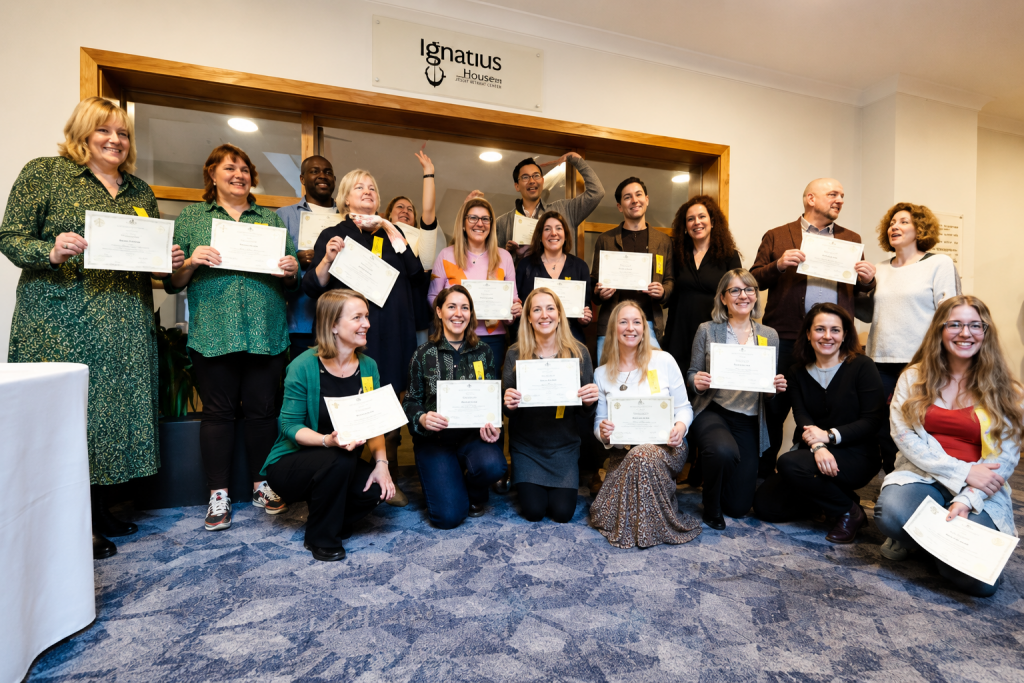
    Candidates, examiners and support team during the EATA examinations in Nottingham, April 2026.

    Front row:

    • Nada Oder CTA (P)
    • Janneke Kierkels CTA (O)
    • Maja Bonacic CTA (P)
    • Jayne Wynne CTA (P)
    • Barbara Nannini TSTA (P)
    • Translator – Valentina Bonomi
    • Ayesha Loveridge CTA (P)

    Middle row:

    • Linda O’Hern TSTA (P)
    • Sheila Beare TSTA (P)
    • Deborah Matthews CTA (P)
    • Anna Chamilothoros CTA (P)
    • Carina Badger CTA (P)
    • Andrea Marconcini TSTA (P)
    • Translator – Giulia De Gioia
    • Simone Puccinelli TSTA (P)
    • Translator – Adele Iozzelli

    Back row:

    • Jeremy Francis CTA (P)
    • Zane Sauka CTA (P)
    • Helen Bailey CTA (P)
    • Neal Edwards CTA (P)

    Candidates together with the Local Exam Supervisors.

    Group photo of examiners, volunteers, translators, Local Exam Supervisors and supporters.

    TSTA candidates

    • Deborah Blagden (UK)
    • Adena Franses (Spain)
    • Pierre Sebregts (The Netherlands)
    • Daniele Mainardi (Italy)
    • Silvia Palandri (Italy)

    Lyn Wall supported the CTA exam process as Inclusivity Champion.

    Examiners

    • Frances Townsend
    • Enid Welford
    • Karen Minikin
    • Harry Gerth
    • Adrienne Lee
    • Cholena Mountain
    • Gemma Mason
    • Helen Rowland
    • Marion Umney
    • Kerri Warner
    • Marijke Arendsen Hein
    • Geoff Hopping
    • Nikki Millard
    • Nicoleta Gheorghe
    • Cathy McQuaid
    • Mo Felton
    • Rosalind Sharples
    • Rachel Cook
    • Nicky Worrall
    • Beren Aldridge
    • Ganna Golovan
    • Wilf Hashimi
    • Robin Hobbes
    • Suzanne Boyd
    • Dave Spenceley

    London, UK

    May 2026

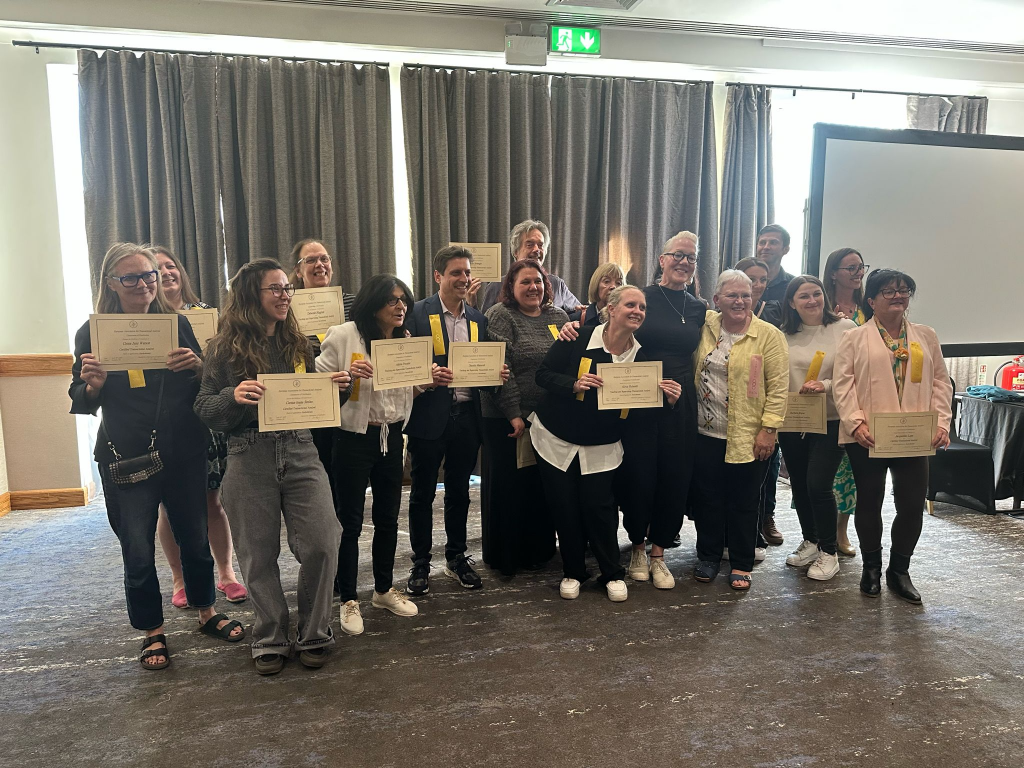
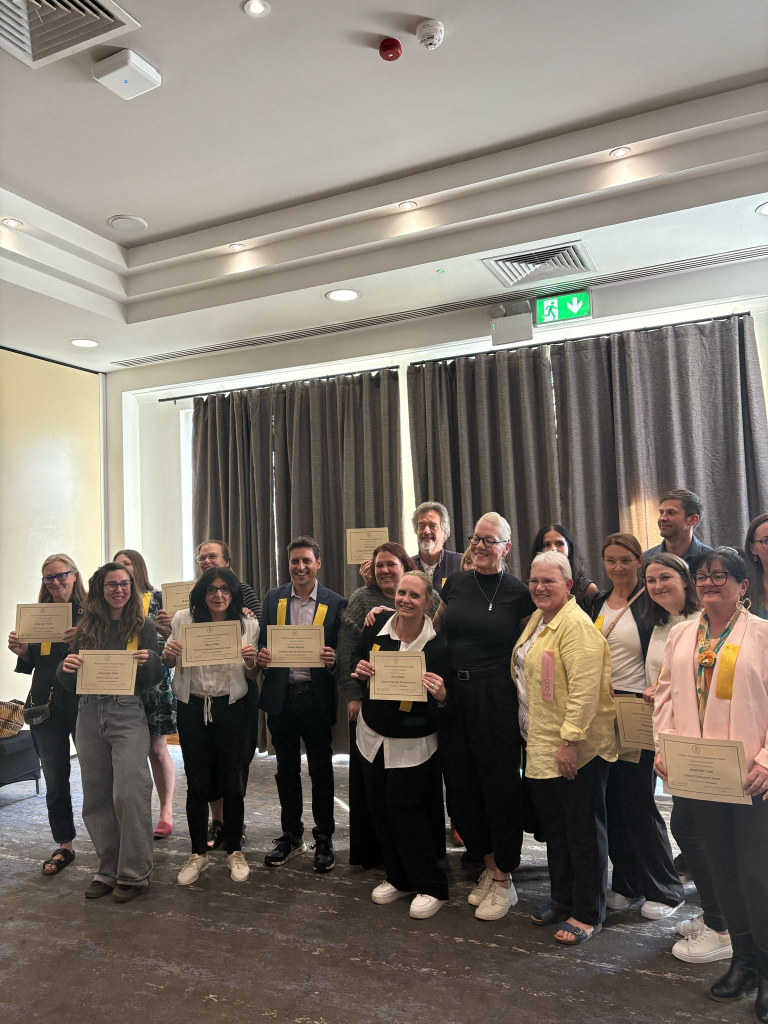
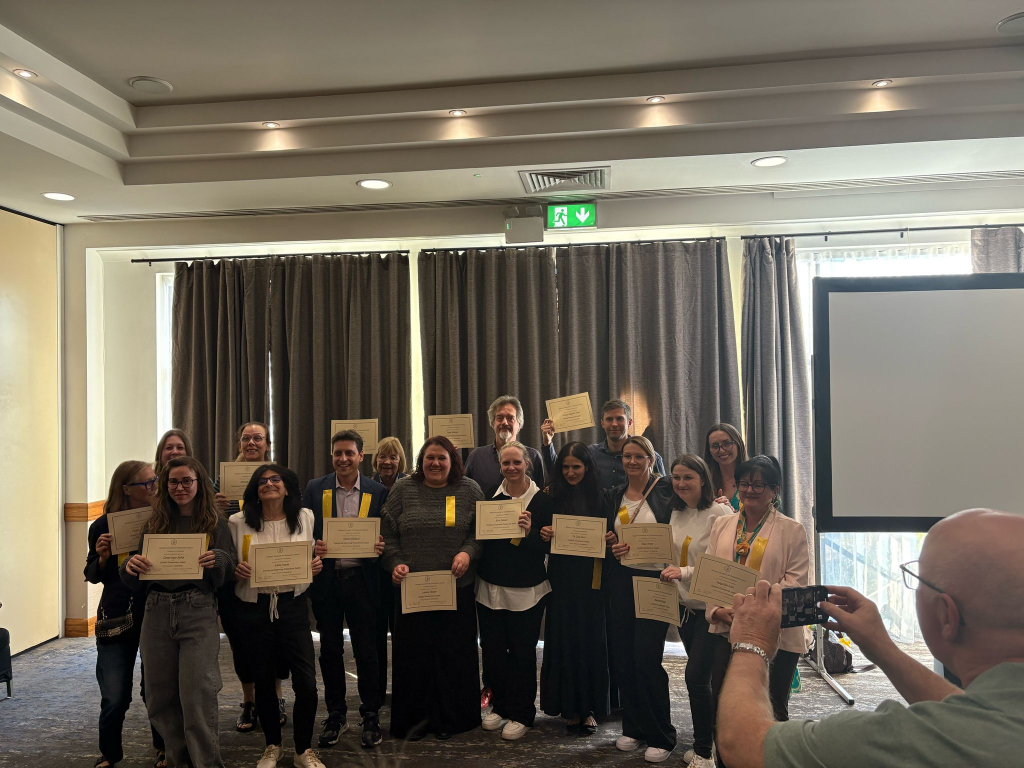
    Successful candidates (all in the field of Psychotherapy) and examiners during the EATA examinations at the Metanoia Institute, London, May 2026.

    Back row (left to right):

    • Sarah Willey
    • Suzanne McKenna
    • Chiyuki Compston
    • Sheila Broadley

    Front row (left to right):

    • Alice Brooks
    • Katy Bradbury
    • Violet Karamagi
    • Mhohn Bancyr-de-Angeli
    • Esther Benson
    • Cat Coleman-Seed
    • Hannah Veseli

    Location: Metanoia Institute, London, UK. COC Representative: Christoph Seidenfus TSTA.

    Local Exam Supervisor: Nikki Millard TSTA. Candidate support: Robin Robinson PTSTA. Process Facilitator: Helen Davies PTSTA.

    We thank all examiners, volunteers and supporters for their contribution.

    Examiners

    • Joan Moore CTA
    • Katherine Collado CTA
    • Trevor Tall CTA
    • Jazz Rehal PTSTA
    • Paula Carr CTA
    • Delilah Zabaneh PTSTA
    • Mike Meleady PTSTA
    • Nadia Manganello CTA
    • Sam Carbon PTSTA
    • Sonja Kormann CTA
    • Samia Nelson PTSTA
    • James King CTA
    • Kate Foster CTA
    • Kelly Donaldson CTA
    • Ronaldo Stroppa CTA
    • Suna Guven PTSTA
    • Jack Pijl CTA
    • Dermot Martin PTSTA
    • Barbara Wattiez PTSTA
    • Emma Black CTA
    • Michael Feat CTA
    • Lee Millward CTA
    • Sarah Magnus CTA
    • Silvia Pellanda CTA