
By Christoph Seidenfus,
COC Chairperson
On 8 and 9 June 2026, EATA examinations took place in Uzhhorod, Ukraine. An unusual location given the strain the country is under because of the Russian invasion and the ongoing war. These were highly successful examinations, resulting in 8 new CTAs and 3 new TSTAs.
The decision-making process between the EC and the COC was shaped by attention to the values of EATA, on which our association rests as a European professional community: professionalism, diversity, accessibility, mutual respect, and the promotion of development across national borders. If EATA wishes to stand for a European community of Transactional Analysis, that aspiration must also be reflected in the geographical and cultural reach of its examination and networking structures.
It is worth reflecting on the strategic reasons why, in future, smaller countries and those in Eastern and South-Eastern Europe in particular might be given greater prominence in the examination and association’s activities. There are not only organisational and reputational reasons for this, but also reasons grounded in the values of our Transactional Analysis community.
A first strategic reason lies in strengthening European legitimacy. If examinations, certifications, and central visibility are concentrated mainly in a few Western and Central European countries, this can easily create the impression of a de facto centralised system. That may unintentionally lead to distance, frustration, or a sense of structural marginalisation, particularly among colleagues from smaller countries or regions that have historically been less strongly embedded in European professional networks. By contrast, a deliberately broader inclusion signals that EATA is not merely an examination body, but a genuine European community. Especially in times of political tension and differing economic conditions, this symbolic effect should not be underestimated.
A second point concerns the sustainability of talent development. In smaller countries and in Eastern and South-Eastern Europe, there are often committed TA practitioners, but local structures are necessarily more fragile. If examinations are held closer to these regions, or if they are given targeted consideration, barriers to access, as well as travel and cost burdens, are reduced, and so too are the hurdles faced by candidates. Strategically, this means that EATA expands its pool of qualified professionals, increases the likelihood of long-term membership, and supports the development of stable local training and supervision cultures. Where access is made easier, commitment grows; where commitment grows, continuity emerges.
For Eastern and South-Eastern European countries in particular, the aspect of resilience through participation is also important. These countries are especially affected by economic imbalances, demographic outmigration, and, in some cases, political uncertainty. When an international professional community is present in such contexts, it has a stabilising effect. This applies not only to individual examinations, but to the wider environment: contact between trainers, examiners, candidates, and national associations promotes professionalisation at local level. EATA would thus not merely be reacting but actively contributing to TA competence growing even where conditions are more difficult. That is precisely where a strategic investment in the future of European TA lies.
It is important here to distinguish between the examination process with its certifications and the relationships within the European TA community. The examination process must, of course, remain rigorous, fair, and quality-assured. Certifications such as CTA and TSTA have significant professional value and must not be diluted by regional sentiment. The point is therefore not to lower standards or politicise examinations. On the contrary, the only strategically sound approach is one that combines high standards with broader accessibility. The quality of the examination remains unchanged, but its distribution, accessibility, and cultural resonance are shaped more consciously.
Relationships within the community follow a different logic from formal certification. Here, the focus is on belonging, exchange, visibility, mentorship, and cultural understanding. This is precisely the level at which EATA can gain much by giving smaller countries, or regions in Eastern and South-Eastern Europe, greater consideration. The community is then experienced less as a centre with a periphery, and more as a network of mutual enrichment. This is strategically relevant because professional associations are sustained not only by examinations, but also by identification, loyalty, and informal cooperation. Those who feel seen and taken seriously are more likely to remain engaged over the long term.
From a reputational strategy perspective, too, broader geographical openness makes sense. An organisation that not only proclaims diversity, but visibly lives it, strengthens its credibility both internally and externally. In a time when European values are under pressure, it sends a powerful signal when a professional association is present not only in the larger and economically stronger countries, but consciously includes those regions that need more support structurally. This applies not only to Ukraine, but more generally to countries at the margins of the traditional European professional landscape. Such a policy is not an act of charity, but an expression of strategic foresight.
A stronger consideration of smaller countries and those in Eastern and South-Eastern Europe also promotes the diversity of perspectives within TA. Different historical experiences, institutional cultures, and social contexts enrich both theory and practice. If EATA systematically incorporates this diversity, it can deepen its substantive work and improve its relevance across different fields of practice. This makes the organisation intellectually more robust. An association that thinks only from within a limited cultural horizon risks overlooking important developments; one with a broader geographical base gains in critical capacity and reflection.
Taken together, there are compelling reasons why EATA should in future give greater consideration to smaller countries, especially those in Eastern and South-Eastern Europe. The issues at stake are legitimacy, reach, resilience, the development of new talent, and the credibility of a genuinely European TA community. What matters most is the balance: high examination standards on the one hand, and conscious relationship- and structure-building on the other.
By thinking these together, EATA strengthens not only individual countries or regions, but the future viability of the association as a whole.
Christoph Seidenfus, COC Chairperson
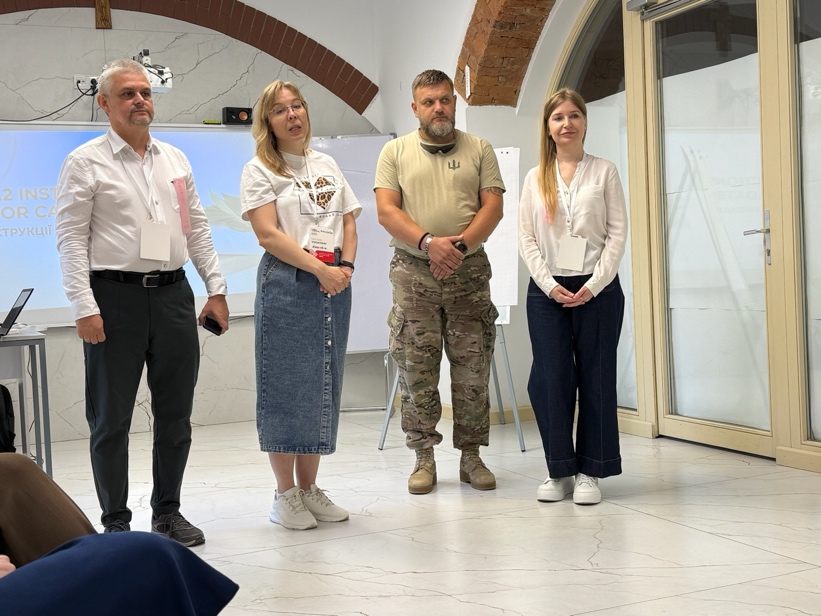
The Ukrainian exam team at the briefings with 8 CTA- and 3 TSTA-candidates:
LES CTA: Serhii Mordiushenko
Translator: Oleksandra Gudkova
Military services: Wolodymir
LES TSTA: Hanna Yavorska
Happy candidates at the celebration of their exam at the ballroom in the Old Continental Hotel in Uzhhorord.